This game is being made right now, during a 4-day contest. This page shows the plan; anything that doesn't exist yet is marked in progress.
The idea
An open world built by its players
Decided
Wyrdale is a top-down online game for many players, with the spirit of the old classics: the freedom to be whoever you want, an economy run by people, and that knot in your stomach when you leave town carrying everything you own.
There is no set path and no class to pick at the start. You arrive with nothing, learn by doing, and help decide what gets built next.
64 players
per server, in the same valley
~1 km²
small enough to cross on foot
0 classes
you become what you practice
How you play
Five ideas at the heart of the game
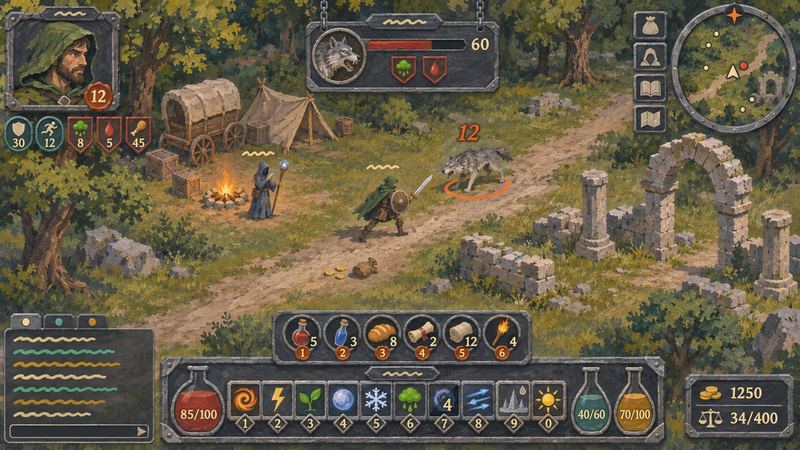
Each pillar below already has written rules. The images are concept art, not game screenshots.
Skill book
Lumberjacking42.3
Mining18.0
Blacksmithing61.7
Fishing7.5
Swordsmanship33.1
Illustrative example
Pillar · Skills
You become what you practice
There is no class selection screen. Every action trains a skill: chopping wood builds Lumberjacking, working the anvil builds Blacksmithing, and trading blows builds combat skills. Skills rise a little at a time, only when you succeed.
And progress means something. A master learns nothing from easy materials. To improve, you have to seek out harder work, farther from town.
Decided
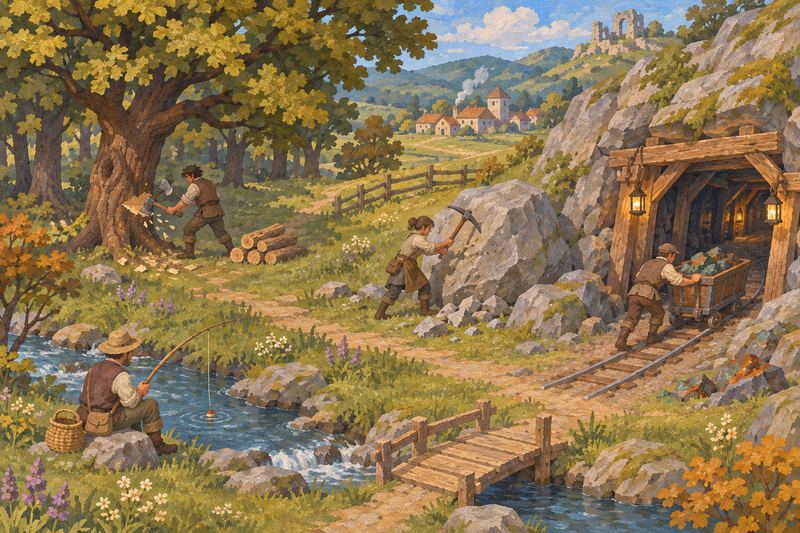
A day of gathering: axe, pickaxe and mine entrance.
Pillar · Gathering
Every tree gives wood. Every rock gives stone.
There are no marked resource fields. Outside town, any tree gives wood and any rock gives stone. Ore lies deeper, in mines, caves and dungeons. The best deposits are to the east and in the depths.
Your chance of success rises with your skill and falls with the difficulty of the material.
If a rare ore is beyond your skill, you get common ore instead.
Wood and stone keep town projects going. While a project is open, gathering them yields more.
Fish in the rivers and the lake.
In progress
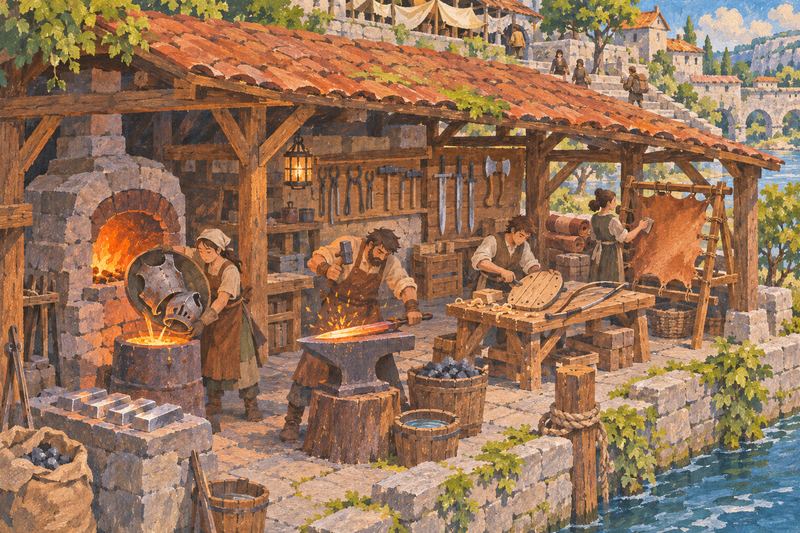
Old armor becomes metal again in the furnace.
Pillar · Crafting
Forge, repair, melt down, and forge again
Forges, anvils, workbenches and campfires are found in the harbor workshops, in villages and, later, in homes. Pick a recipe and a quantity, then make each piece one at a time.
Three qualities: crude, normal and exceptional. An exceptional piece can carry your maker's mark.
Repairs restore durability, but each repair lowers the maximum a little.
Worn-out gear still has a use. Melt it down or take it apart to recover some materials. Today's battered armor is tomorrow's sword.
In progress
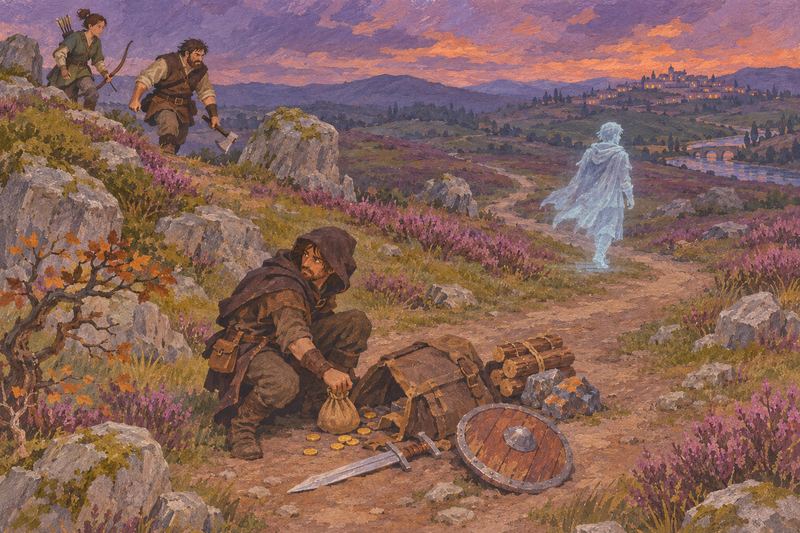
On the road at dusk, whatever falls belongs to whoever gets there first.
Pillar · Full loot
You are safe in town. Outside, you could lose everything you carry.
The Steps are a protected area. Beyond the last fence, death leaves your body behind with everything you were carrying. Anyone can take it.
If you fall, you become a ghost and return to the town shrine to begin again. Keep what you don't want to risk in the bank.
That is why gear is cheap: a basic set costs less than half an hour of work. Losing it hurts, but it won't ruin your week.
Decided
One conversation, one new clue.
Pillar · Discovery
Talk your way into the story
The story doesn't come in an opening wall of text. You find it by talking to the locals, in your own words.
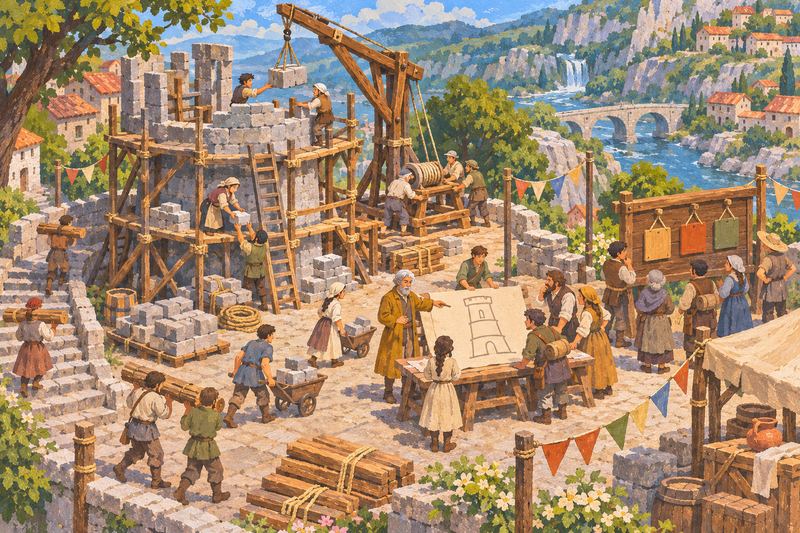
The Steps have no king. Since the Pact that founded the town, the council of trades has made requests and the people have built them. In the game, these become community projects. Any player can bring wood, stone and other materials to a building site. Each finished project changes the world for everyone.
The tower rises as the town brings wood and stone.
I
The first project
The first project: the Arcane Tower
Before the tower, there is no magic in the world. It is not locked away; it simply does not exist. Once the last stone is laid, the tower opens a shop selling reagents and scrolls. Magic and meditation become available to anyone who wants to learn.
In progress
Then the town votes
Bringing materials to a building site is a vote for that project. The scoring favors many people taking part over one person with many accounts. Each vote offers three different paths: a new trade, an infrastructure project, and something social.
01
The Arcane Tower
introduces magic and meditation
In progress
02
First vote
Alchemy lab
East bridge
Scholar's archive
03
Second vote
Farm
Player market
Fishing dock
04
Third vote
Stable and mounts
Watchtower
Duel arena
Projects that lose return in later votes. A building may be finished before its system is ready; in that case it is marked waiting until the trade arrives in the game.
Planned
The story
Nobody knows the whole story
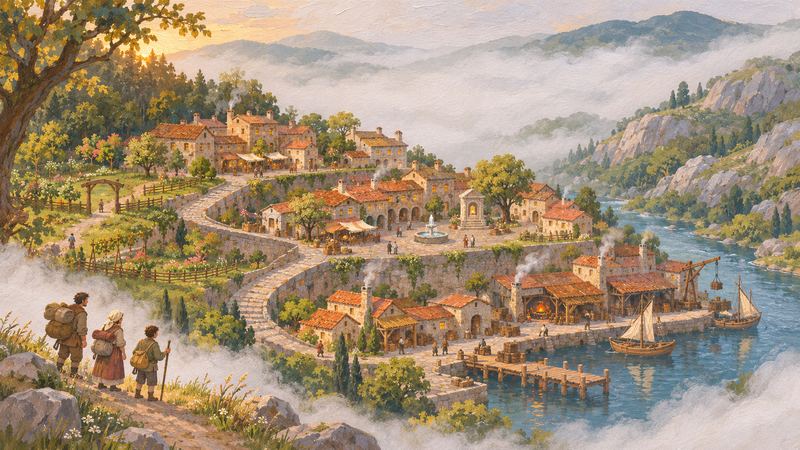
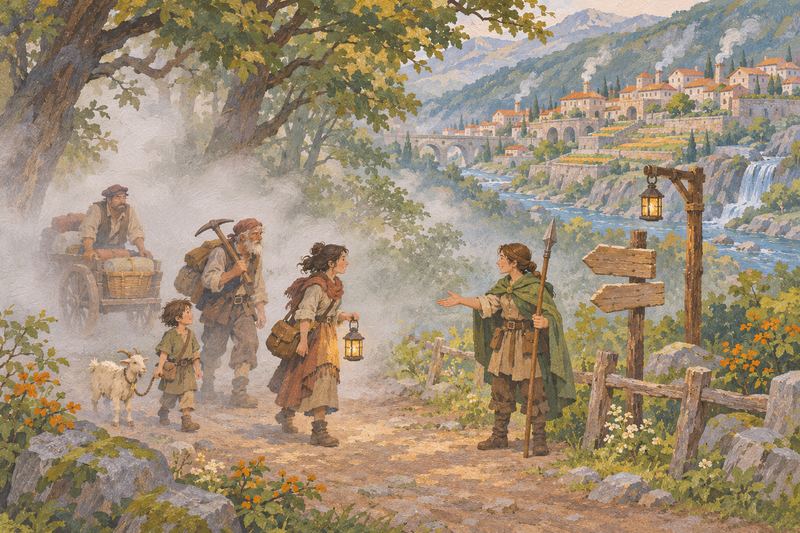
In a single night, the roads linking six kingdoms came loose like threads in old cloth. Travelers walked into white mist and emerged in the same valley: stone terraces cut into a hillside, a slow river, a shrine that restores life, and the ruins of an unknown people.
Seven years on, the refugees have built a town without a king. Nobody can leave. Walk into the mist at the edges and you come back along the boundary. People still arrive from time to time. You are one of them.
People still arrive through the mist, unable to remember the way.
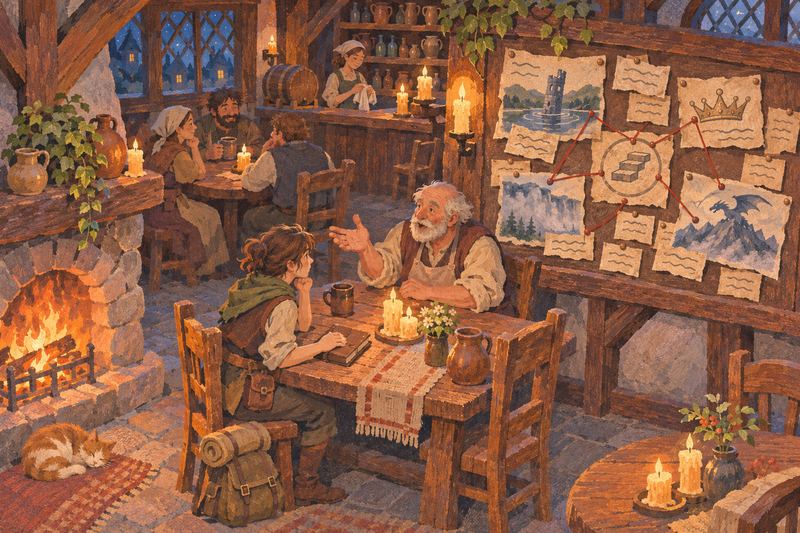
At the tavern, a conversation can become a page in your Journal.
Talk in your own words
Type what you want to ask. Each local answers in character, with their own voice and memories. Everyone holds a piece of the story, and some take time to open up. Trust grows through conversation, trade, helping out and work on town projects.
What you learn goes into your Journal, arranged in chapters, with gaps that suggest who to ask next.
Build your own investigation board: rumors, conflicting accounts, clues.
Locals lie, too. When you find the truth, the contradiction shows up.
If text conversation is unavailable, the local offers a menu of topics and the game carries on.
Pages of the Journal
I. The Arrivals
II. The Lost Kingdoms
III. Stones That Were Here First
IV. The Fallen Crown
V. The Dead and the Mountain
VI. The Deep Tower
VII.Still blank: "Nobody knows yet."
First steps
Quests and tutorial
The tutorial is a quest like any other. It teaches you to move, gather, craft and fight, then leaves you in the town square, ready to choose your own path.
Quests respond to what you do in the world: gathering in a region, crafting an item, talking to someone or delivering building materials. They can branch with your choices. The town project has its own cooperative quest.
In progress
Example
Timber for the tower
☑done: Talk to the architect
☑done: Cut 20 logs in the Old Forest
☐to do: Deliver the logs to the tower site
RewardThe architect's trust
The world
Dawnsteps
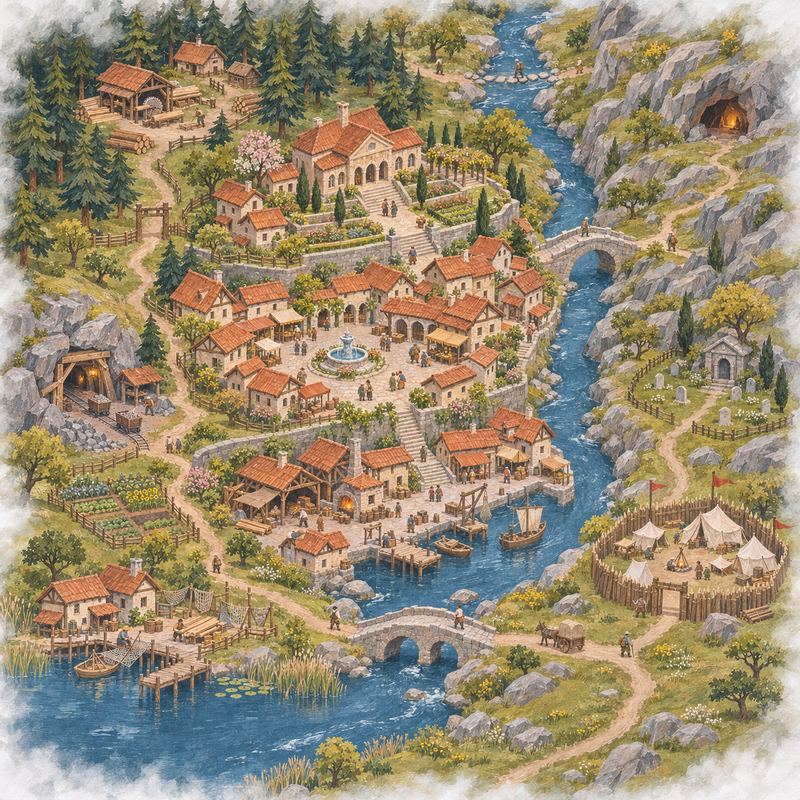
A valley enclosed by mist, small enough to cross on foot. At its center, the town steps down to the river on three terraces. It has no walls, only vegetable gardens, low fences and gateways along its edges.
One valley, many paths. Explore the nine places in the legend.
These are working names. The game map is generated from this layout and is still a rough blockout.
Layout DecidedIn-game map In progress
Who stands out
Rankings
Coming soon: the leaders in each skill, the biggest contributors to town projects, and other highlights, straight from the server.
Planned
The rankings couldn't be loaded right now.
Behind the scenes
How it is being made
Wyrdale is being made by one person working with a team of AI agents, during a 4-day contest. The agents write specs, code and tests; the design calls belong to the project's owner.
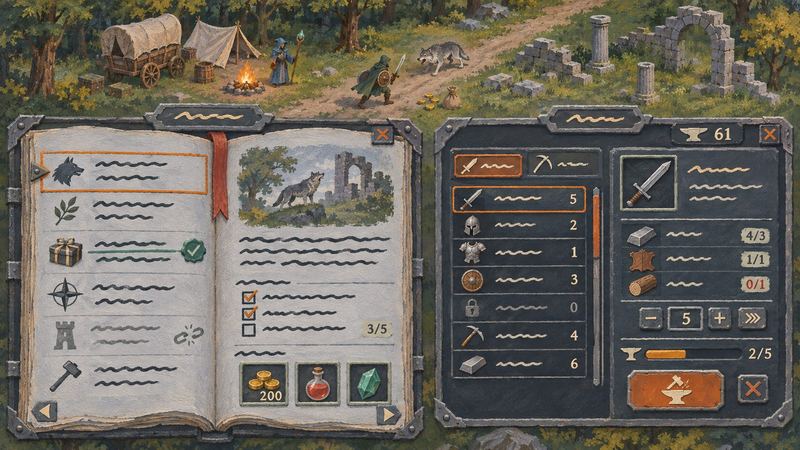
The art is AI-generated and human-directed: every image on this page started from a style brief (gouache, slate and codex), was reviewed, and was redone when it needed to be. The interfaces below are style studies, not game screenshots.
A lot of what's on this page doesn't exist yet. We'd rather show the plan honestly than promise what isn't ready.
Interface study in the Slate theme.Journal (Codex) and crafting study.